
Will an AI Help Desk Replace Tier 1? No. Here's the Math
Is AI gonna replace your help desk? No. An AI help desk won't replace Tier 1, because Tier 1 is just the first person to get assigned a ticket, and what they work keeps changing. A ton of vendors selling AI for MSPs will say, "Buy our tool, and you'll replace your Tier 1." Let's be real: Tier 1 is the guy that answers the phone first.
And the most common thing I hear in MSPs is "Can someone pick up the damn phone?"
By the end of this, you'll know what Tier 1 does in the AI era, and how to tell if the tool you're eyeing will ever pay back the reorg. I ran an MSP as its operator, and now I coach MSP owners.
The Short Version
- AI takes today's common tickets. Tier 1 checks its work and takes the client who's done with the robot.
- An AI tool only saves money if someone leaves payroll or the next hire doesn't happen.
- Tier 2s come out of Tier 1. Cut Tier 1 and you've cut the bench.
- The reorg costs more than the tool: somebody has to build it and run it, and everybody has to learn it.
- A tool that saves $500 a month can take over four years to pay back.
The episode this post comes from: "AI for MSPs: Will an AI Help Desk Replace Your Tier 1?"
Is AI Replacing the Help Desk?
No. Tier 1 is the first person in line, and what they work is what keeps changing. Tier 1s are expected to work your most common tickets, and your most common tickets are the things you document, standardize and train your team to do.
A Tier 1 used to solder capacitors onto motherboards and change UPNs in Exchange. Self-service, Microsoft 365 and the cloud automated that work away, and Tier 1s just got new issues to handle.
So when somebody says Tier 1 is going away, they mean Tier 1's gonna be doing different things. So can we pick better words, please? I'm tired of hearing this at conferences and in people's marketing.
As AI tools get better, your Tier 1s might be:
- doing more QA
- approving things
- recognizing things that aren't documented, that the robots can't make a decision on (and we all know we have perfect documentation)
- handling the purely conversational stuff, like someone dialing zero in the phone tree to talk to a person
The Lawyer Who Was Done With the Robot
I'm making this example up, but we all have this customer: a lawyer with something to print for an important case in a few hours, and that damn printer's not working.
The robot relentlessly tries to fix the problem, but it's not gonna think outside the box. By the time he gets to a human, he's frustrated, and he won't give you as much information as you'd like, because he already gave it to the robot. And the robot never thought to ask, "How long do I have to fix this?"
So your Tier 1 has to be trained almost like somebody in hospitality: calm him down and give him the confidence he finally has the right person. That person's gotta be prepared to say, "This guy's been through it. What's the next thing?" Maybe it's "There's a print shop downstairs. I'll call them for you."
By then, he just wants a person.
Tier 1 Is Where Your Tier 2s Come From
Tier 1 is where your Tier 2s come from, and you're gonna have to either steal them, which means overpaying, or develop them. We wrote up how to grow your Tier 1 techs into Tier 2.
The Cashier's Second Job
Dollar General had already pulled self-checkout out of 12,000 of its more than 20,000 stores by May 2024, and its CEO, Todd Vasos, called shrink (inventory loss) "the most significant headwind in our business" (Retail Dive, May 31, 2024).
Self-checkout wasn't the only reason for the shrink. But here's my take: you end up hiring more security guards or spending more CapEx to fight self-checkout theft, because automated checkout got rid of the cashiers who were inadvertently protecting against shrink. That cashier had a second job that nobody wrote down. Your Tier 1 has one too.
Steal a Tier 2 or Grow One?
There's a study on hiring internally vs. externally. In one US investment bank's data, people hired from outside started on about 18% more pay than people promoted into the same kind of job, and the promoted people performed significantly better for their first two years (Bidwell, "Paying More to Get Less," 2011). I'd guess it's because they already understood the business.
The Tier 2 you hire from outside has bad habits from their old MSP. And the Tier 2 you steal from another MSP still has to develop the people skills.
There's probably a hard truth in this for your Tier 2s and Tier 3s. Tier 1s are gonna get more agency to use AI, so knowing the fix off the top of your head is becoming a little irrelevant. The definition of hard might change to relationship-based, solutioning-based or sales-based.
The Tool Is the Cheap Part. The Reorg Is the Expensive Part.
Today's tools are way better than LabTech was, but the tool is still the cheap part. My Empath co-founder Alex Farling and I have talked about this a lot on our podcast. Back when he ran his MSP and I ran mine, we were both sold LabTech, an RMM, on the promise that it'd replace a Tier 1.
But I had to hire a Tier 3 to build it. My team had to learn the RMM and then how to make it useful, with skills like PowerShell.
A year or two down the road, we'd only used 10% of the features, and I never actually got rid of that Tier 1 person. I put the workload on my Tier 3, which meant I needed another person to take the extra work off him. None of us had the nerve to let the Tier 1 go, and we ended up with a tool and an extra employee.
The Profit Math Vendors Sell vs. What Actually Happens
For a lot of us, the math goes like this:
- Today: revenue minus labor minus stack equals profit.
- What we expect: revenue minus labor minus stack plus AI equals more profit.
- What happens: revenue minus labor minus stack minus AI minus the person using the AI equals less profit.
None of us have the nerve to trim labor, and most of us don't grow enough to grow into the added capacity the tool gave us. It's Clark Griswold opening his Christmas bonus expecting the check for the pool and getting the Jelly of the Month Club.
There's data to back this up in our space. Service Leadership, a ConnectWise company, found in its 2026 Annual Profitability Report (the executive summary is a free download) that for managed-services firms from 2021 to 2025:
- tools went from 10.8% to 13.8% of revenue, which it puts down to "cost increases from vendor AI investments"
- payroll's share came down from 43.7% to 41.6%
- service margin slipped from 45.4% to 44.7%
In their words: "Currently, the data has not shown the benefit of the investment in vendor costs."
ConnectWise's own CEO, Manny Rivelo, put the small-shop version on record: "When you're a small MSP, and you have 14 technicians, we could reduce your ticket count, but you can't repurpose a body" (Channel Dive, June 8, 2026).
With AI, the Savings Are People: Which Name Comes Off Payroll?
With AI, the savings are people. Either a name comes off the payroll or you don't hire the next one. And if neither happens, there are no savings. So before you believe any AI cost savings, ask the vendor and yourself: which name comes off my payroll?
On the body, I agree with Rivelo. Say you've got eight on your help desk today:
- With the robots, maybe you need only four on tickets.
- Then you need one running the robots and one building them.
- That's six people. Two names came off your roster.
Hire somebody new to run the robots before those two come off, and it's exactly the situation I had with LabTech: a tool and an extra employee.
If your whole shop is five people or under 10, you don't have a Tier 1 to sacrifice anyway. Look at it as a capacity tool you buy to avoid hiring the next body. You're still adding a tool without adding revenue, so growth is still the thing you need.
And for the bigger shops, you're gonna have to either fire somebody or not replace somebody when they leave.
Four Questions to Answer Before You Buy an AI Tool
Before you buy anything new, I don't care how cool and favored everybody thinks it is, you need to answer these questions:
- What outcome am I expecting?
- What deadline am I expecting for that outcome?
- When am I gonna check in on the progress?
- Who on my team is gonna own that outcome?
It's that last one that's big. The reason the robots won't fix your margin: nobody in your company is accountable for the profit the robots are supposed to make. Settle that before you sign, with a RACI that names who owns it.
How to Calculate the Payback Period on an AI Tool
Payback period in months is the switching cost divided by the monthly savings. Switching cost is the hours your people spend making the change, times what an hour of their time costs you, all in. If the tool saves you nothing, it never pays back.
Back in the day, we had an RMM calculator at my consulting firm. You'd fill out five or six fields, and it'd tell you how long a tool that's $500 a month cheaper would actually take to net you a profit. Because switching isn't free. You've got to:
- migrate to it, learn it and train on it
- build standards around it and deploy it to all your customers
- move everything off the old one, backing up what you need first
- fight with the vendors and do the proofs of concept, even before you buy
I don't have that calculator anymore. Roughly, the math went like this:
- Say all of that took 500 hours of your people's time. You might have 20 people on your help desk who each take five to 10 hours just to learn it.
- At $50 an hour, all in, that's $25,000 to switch.
- At $500 a month in savings, that's 50 months before it nets you anything. Over four years.
So, same question with AI: how much time are you going to spend reorganizing the company before this actually nets a savings? I built you a version of this calculator.
Get the Payback Calculator
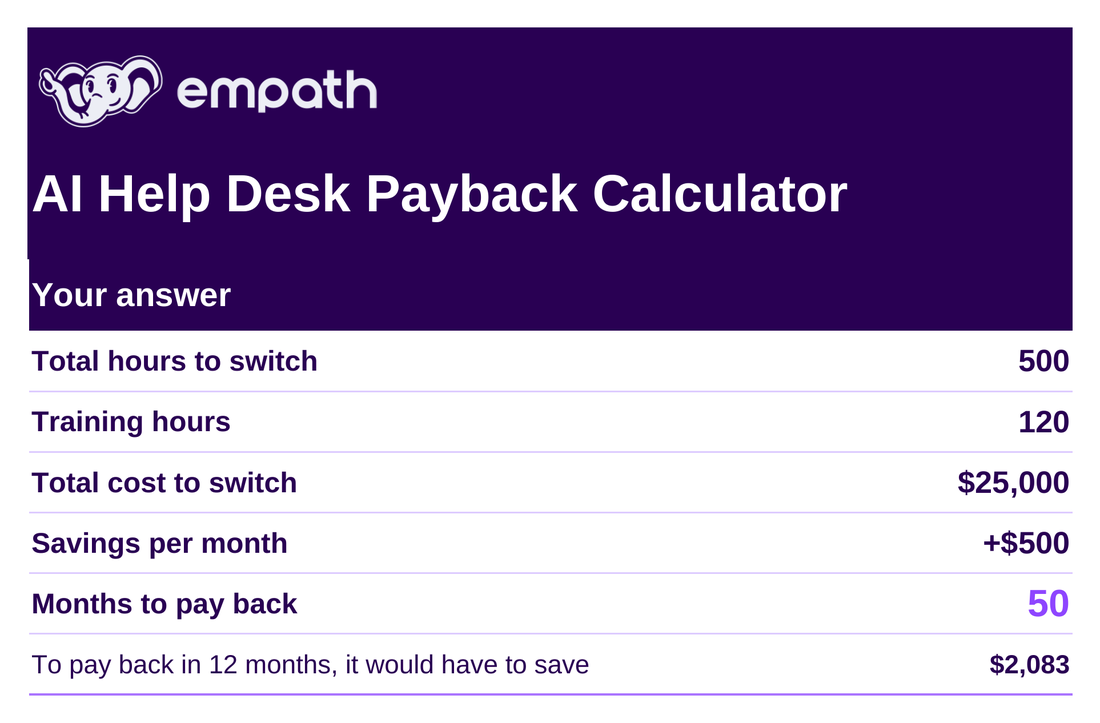
A payback period calculator in Excel, with a tab each for an AI help desk, an RMM, a PSA and a security tool. Each one shows how much of the switch is training. Enter your work email and the download link shows up right here.
Or try Empath Learn, the training platform for you and your team, free for 14 days.
Decide What the Hours Are For
The robots are going to free up hours. Somebody has to decide what those hours are for: fewer people or more customers with the same number of people. You don't have to be the first MSP to buy the tool. You can't afford to be the last one to decide what the hours are for.
And yeah, we sell training, so run your four questions on us too. Whatever you decide, your Tier 1 needs the skills the robots don't have. Every Empath Learn seat includes help desk training like Soft Skills for Techs, Conflict De-Escalation and Customer Service 101, which comes with an AI roleplay for handling an upset customer. There's also AI Essentials for Your Service Desk and a T1 pathway template.
Run the payback calculator first, or grow the Tier 1 you have with Empath Learn, free for 14 days. Then tell me in the comments on the YouTube episode: what's the most common ticket your Tier 1s work today that didn't even exist five years ago? Stay accountable.
Frequently Asked Questions
What is an AI help desk?
An AI help desk, or AI service desk, is software that works tickets before a person does, like password resets that close themselves. It still needs people to build it and run it, plus a Tier 1 for what the robot can't decide.
What tasks can AI replace?
AI and help desk automation can take routine, well-documented tasks, like password resets and the first pass at a common ticket. They struggle with undocumented work, decisions they aren't allowed to make and people who want a person. Check whether AI is helping your service desk or just creating more noise.
What is a Tier 1 help desk?
A Tier 1 help desk is the first line of support: whoever gets the ticket first. Tier 1 techs work your most common tickets, the ones you've documented and trained for, so a higher-paid tech doesn't have to. Tier 2 takes what Tier 1 can't close, and you can grow a Tier 1 tech into Tier 2.
Is AI taking over customer service?
AI is taking over the routine part of customer service, like resets and the first round of troubleshooting. The part customers remember still takes a person: calming down someone who's already fought the robot and finding a fix outside the script. Train Tier 1 for that.
