
How to Grow Your Tier 1 Techs Into Tier 2
If every MSP only wants to hire Tier 2s and Tier 3s, where exactly do new Tier 2s come from? They come from your Tier 1 techs, once somebody hands them Tier 2 work. You can grow the Tier 2 you can't afford to hire out of the Tier 1 you already have, thirty minutes a week at a time.
I grew an MSP from $2M to $20M as its operator, and now I coach MSP and service-business owners. If you're the owner who's been saying "I can only hire experienced," this one's for you.
The Short Version
- Hand your Tier 1 a Tier 2 ticket, with someone close enough to catch her.
- Before you blame a new tech for a missed ticket, check the SOP, the training and her calendar.
- Fix one gap at a time, with paid time on the calendar every week.
- AI gives the newest or least skilled workers the biggest lift, but in one study it steered even skilled consultants wrong on work it couldn't do. Your Tier 2 becomes the catcher.
The episode this post comes from: "MSP Talent Shortage? How to Grow Tier 1 Techs Into Tier 2"
What's the Difference Between Tier 1 and Tier 2 Support?
Tier 1 and Tier 2 are the first two levels of help desk support, and a ticket moves up until somebody can close it.
- Tier 1 takes the first call and the everyday ticket.
- Tier 2 takes what Tier 1 can't close.
- Tier 3 is the deepest person in the building. In a small MSP, that's usually the owner.
We hire somebody into Tier 1. We give 'em the Tier 1 tickets. Anything remotely complicated gets escalated. And then 18 months later we wonder why they're still a Tier 1.
Is It a Talent Shortage or an Opportunity Shortage?
I'm not sure we have a talent shortage. We might have an opportunity shortage. If somebody needs Tier 2 experience before we'll give them Tier 2 experience, that's on us. MSPs are my examples. Any service business with one green person? This is yours too.
Why You Can't Just Hire the Tier 2
In a price-conscious product, margin only happens if I can control the cost of my labor, and I can't do that hiring extremely expensive people. So the question is "what skills can we afford?"
And I can hear it now: you train 'em up, and the day they're worth it, they walk down the street for more money. Yeah. Some of mine left. Some stayed. Hell, a few started their own businesses, some of 'em MSPs. So yeah, it's real. Promoting from within still wins: hiring around it costs you more.
If You're the Owner, You Are the Tier 3
Now, if you're the owner, you ARE the Tier 3. Which is why you can't go to a networking event, take a sales call, hell, take a vacation. Todd Kane of Evolved Management, a partner of ours, says it all the time: we get caught up in being busy.
I'd have owners track two weeks of their calendar. Nine times out of ten, it came back as tickets. Reality check: if you have to be the top tech, you're not charging enough for anybody to help you.
If it's one or two of you trying to grow, you're usually better off with the apprentice. Somebody who shadows you and learns the way you like it done.
Career Development vs Role Development: Which One Is Yours?
Career development is the employee's: their goal, their push. Role development is yours: the skills the job needs, which is the reason you hired them. There are two kinds of development, and most of us overemphasize the first and completely forget the second.
Say you hired her on Monday. She's green. She's made up, by the way, but you've got one just like her. If she has a career development plan, great. That's her push.
She's worked a service desk before. She knows how to work a ticket. What she does not know is the way my shop does it. That's on me. We wrote up how to build MSP training pathways for the role side.
What Should a New Tier 1 Tech Learn First?
Just four things: your ticketing system, your time entry, where your process lives and when she escalates. Those four things are her whole job for the first two weeks. Once she can do them, find where she makes a mistake and build the next thing around that.
At Geek Squad, back in 2003, the one thing was ringing up the register. Check somebody in, take their money, let somebody else fix the computer. Fourteen days and that person was productive, by that definition, and the person who could actually fix the computer wasn't stuck at the counter. Training somebody to pull a virus off a machine, back in 2003? Could've been nine months. Twelve months. Teach the register.
For a fuller training plan for new employees, use our IT onboarding checklist for a new MSP hire.
Accountable to What? Why a New Tech Misses a Ticket
People miss a task for one of three reasons: they didn't know, they didn't know how or they didn't have the time. The SOP, the written way we do a thing here, fixes the first. Training fixes the second. That leaves time: did we give her the space to do the thing?
Ask for the training and never give the time, and that's how a help desk burns out.
The SOP Minefield
Except here's what actually happened in my MSP. Our SOPs lived in our documentation tool. In a folder, inside a folder, among a thousand other folders, right next to the server passwords. The only time anybody found one was when somebody passive-aggressively Slacked you the link and slapped you upside the head with it. We called it the minefield. You become accountable for something you didn't even know existed.
If you wanna hold her to the SOP, she has to be able to FIND it. That starts with getting what your senior techs know out of one head.
Follow the Recipe to the Gram
Quick story. I'm learning to make pizza. First time, I followed the recipe to the hundredth of a gram, 'cause I'd never done it before. Best pizza I ever made was the third or fourth one, because I didn't change a thing. Fifteen pizzas in? I started improving it. Sometimes it got worse. A little too chewy.
That recipe is the SOP, the written way we do it. While she's new, she follows it to the gram, and it works. Sometimes the skilled guys, the Tier 2s, the Tier 3s, the people who've been around 20, 30 years, are the ones who've learned shortcuts. If you wanna change the recipe, say so out loud, and somebody checks it.
How to Build a One-Page Employee Development Plan
A one-page employee development plan names one skill nobody else here has, one learner, one person who catches their mistakes and thirty paid minutes a week. It ends with the steps written down, so the next person can follow them. The whole employee development and training plan fits on six lines.
- Their first two weeks. Tickets, time entry, where the process lives and when to escalate.
- What nobody here knows how to do. As we find things we don't know how to do, let's write them down.
- Pick one. One thing, this month or this quarter.
- Who's learning it? The learner, and who helps her.
- Thirty minutes a week, paid. On the calendar, on the clock. If the queue keeps eating it, put training in the ticket flow.
- Write down how it's done. Checked by someone who knows it.
One employee development plan example, from an MSP: say you notice a high rate of tickets getting escalated out of Microsoft Entra, Microsoft's sign-in and identity system. Let's find that one employee, by volunteer or by assignment, and give her time on the clock, because the business needs her to take the Entra course.
Two Kinds of Things on the List
If somebody in the shop already knows how to do it, let her touch that Tier 2 ticket. Have someone close enough to catch her before wrong gets expensive. If nobody in the shop knows how, she takes the course, and now somebody in the building actually knows it.
In my MSP, when a Tier 2 caught an escalation, they wrote down the fix so a Tier 1 could do it next time, and the Tier 3 checked it. Over time, you should see the escalations drop. In Empath Learn, the training platform for you and your team, you can turn that written fix into a course of your own.
Volunteer or Assigned? Say the Real Thing
The eager one raises her hand. And if nobody raises their hand, you get to select. It's your business.
And call it what it is:
- Your job description needs you to do this.
- To promote you, you need to learn these things.
- If you don't do these things, I'm either gonna fire you or you're not getting the promotion.
A lot of learning platforms wrap that in "we're helping your career." That's almost a fake benefit. Say the real thing.
Get the One-Page Employee Development Plan Template
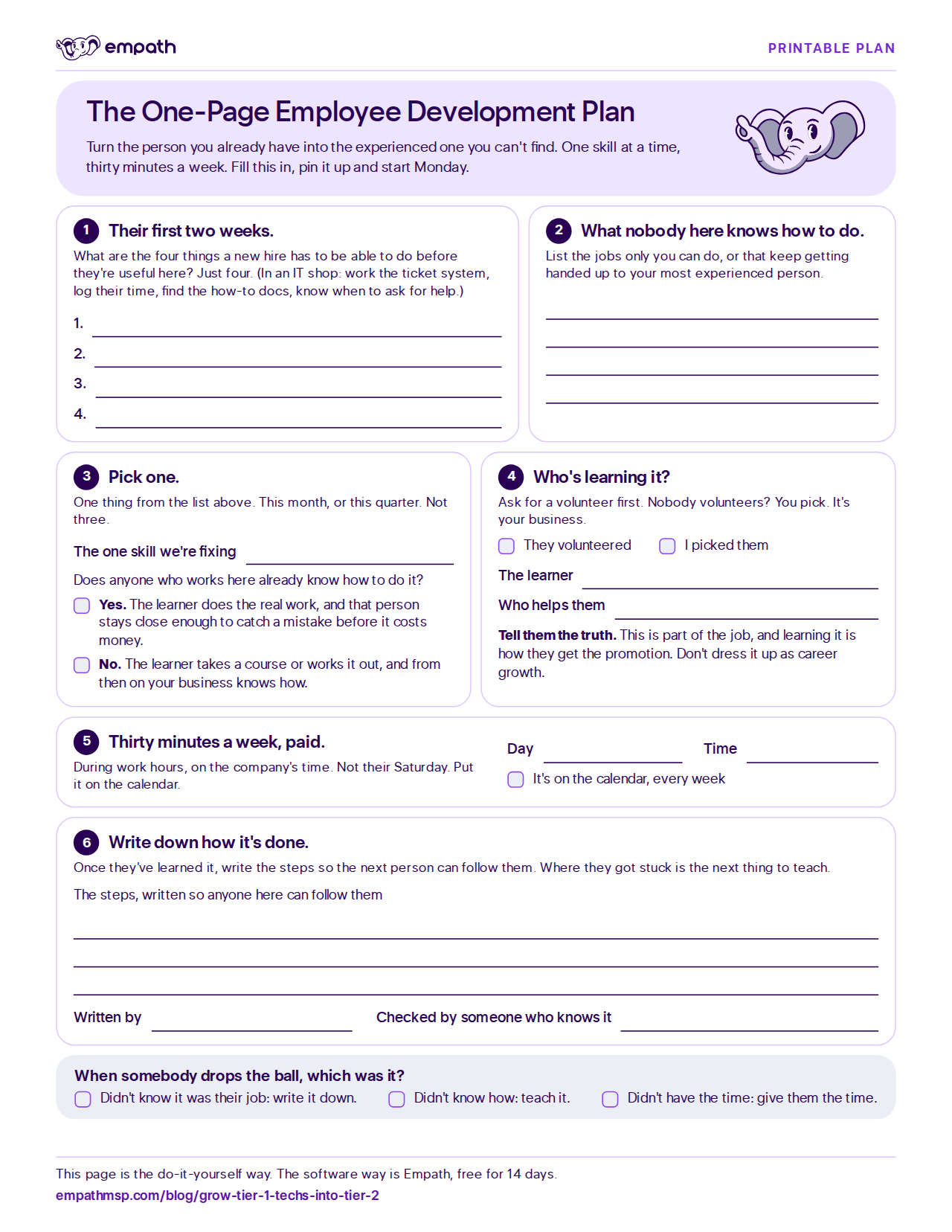
The one-page plan works for any service business with one green person. Enter your work email and your link to the fillable PDF shows up right here.
Prefer software? Try Empath free for 14 days.
What Does AI Change for Tier 1 and Tier 2 Techs?
In four studies, on support agents, coders, consultants and writers, AI helped the newest or weakest workers most on work it could do. One of them, the consultants, found that on work the AI couldn't actually do, the people leaning on it did worse. That's why a Tier 1 using AI still needs a Tier 2 close enough to catch her.
Is AI replacing entry-level jobs? There's a payroll study on this. Stanford's Digital Economy Lab found in ADP payroll data that employment of 22- to 25-year-olds in the jobs most exposed to AI fell about 11% from November 2022 to June 2026, while the same age group in less-exposed jobs grew about 10% (Canaries in the Coal Mine?, August 2026). Most of that drop came through companies hiring fewer of them. The authors won't say AI caused it. I'd just say: that's the opportunity shortage.
The same paper puts computer user support specialists, the help desk job, in its most AI-exposed group. Now, I never ran an MSP in the AI age, so for techs I'm going off what I hear from MSPs who have.
The Tier 2's New Job: Catcher
So here's the question for your Tier 2s and your Tier 3s. Are they willing to change their stripes? The new job is writing down how it's done, and catching the kid when she gets it wrong.
The first server I ever set up? We'd never done one at Geek Squad. I brought the smartest person on our team and said, "I'm not doing this alone. I'll do it. I just need someone to be a little bit of a mentor to me." That person was my catcher. I did the work. They made sure I didn't do it alone.
Shadowing still has its place. We compared shadow training with a training plan for MSP teams.
Back to the Owner Who Can't Take a Vacation
This one page is how you get out of the building.
And yeah, the training-software guy wants you to buy something. I built Empath to make the role-development side of this simpler. In Empath Learn there's a T1 pathway template for new technical hires, plus Empath courses like Ticket Escalations 101. For a gap like Entra, there are more than 40 Microsoft Learn and Curated Collection titles to assign.
So this post has both. The pen-and-paper way, or fourteen days of the thing we built, free, if you wanna mess with it.
The Pen-and-Paper Way
The one-page plan, ready to fill in on screen or pin up by Monday.
It's like that kid in Sandlot. Nobody wanted him on the field, until Benny handed him a glove and showed him how to catch. Her next ticket is a Tier 2 ticket. Let her touch it. Tell me in the comments on the YouTube episode: who handed you your first Tier 2 ticket? Stay accountable.
Frequently Asked Questions
What is a development plan for an employee?
A development plan for an employee is a written plan for the next skill they'll learn. Keep it to one page: the skill, the person learning it, someone who catches their mistakes, paid time each week and the steps written down once they've got it.
What should I write in my employee development plan?
Six things, in order: the four things a new hire must do in their first two weeks, the jobs nobody else here knows how to do, the one you'll fix first, who's learning it (and who helps), thirty paid minutes a week and the written steps.
What is the benefit of promotion from within a company vs. hiring from outside?
Internal promotion costs less and keeps your way of doing things. An experienced outside hire has their own methods, so you end up micromanaging them or at odds with them. A Tier 1 you grow learns the way you like it done. Some you grow will leave, and hiring only experienced people to avoid that costs more.
What is Tier 3 tech support?
Tier 3 is the deepest level of technical support: the senior person who takes what Tier 2 can't close. In a bigger MSP it's a few senior engineers. In a small MSP that's usually the owner, so every hard escalation ends at one desk and nobody new learns that work.
