
Why Your Current MSP Training Program Is Causing Help Desk Burnout
If you look at your MSP team right now, does it feel like they still have that spark of curiosity...
You’ve probably felt the frustration of finding someone with the right certifications, who understands your stack and closes tickets within SLA—someone who, on paper, is a strong hire, and yet… clients still complain.
So, the question becomes: is technical ability enough?
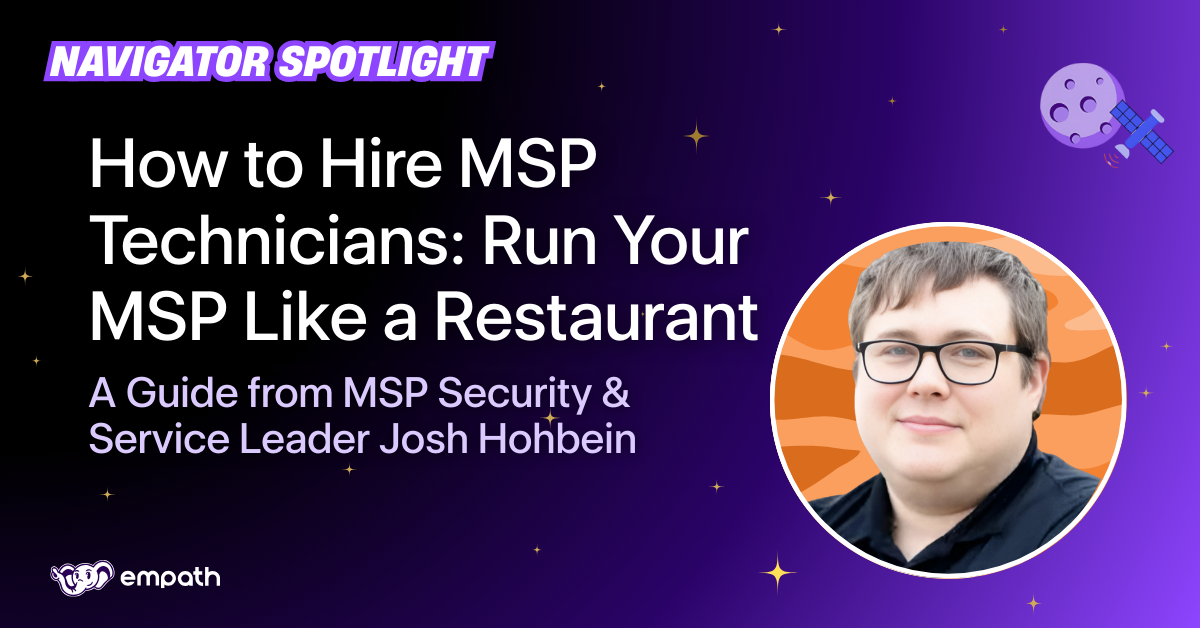
Many owners struggle to figure out how to hire MSP technicians. The default has been to check for certifications, tools, and years of experience. But Empath Navigator and MSP Security & Service Leader Josh Hohbein believes that this filter is fundamentally incomplete; that running an MSP is far more similar to running a restaurant than most owners realize.
He presents that just like in a restaurant where the meal is expected but the service is what people remember, the MSPs that thrive are the ones that hire for both skill and service.
Here’s why the value of hospitality, second nature in guest-facing businesses, may be the hiring lesson your MSP has been missing.
.png)
After spending about five years in the MSP world, Josh stepped away from IT and into restaurant management. He helped open new locations, trained staff across front-of-house and back-of-house roles and oversaw day-to-day operations. It was a fast-paced, high-pressure environment where timing, communication, and teamwork determined whether guests walked away satisfied or frustrated.
When he returned to the MSP space, the parallels were hard to ignore.
Requests arrive back-to-back, priorities shift without warning, and teams must coordinate in real time, passing responsibilities between roles without losing clarity or momentum. When communication breaks down, whether between cook and server or technician and dispatcher, the impact is rarely isolated.
That overlap changed how he views service entirely. Both industries are built on execution under pressure, but the lasting impression is shaped by communication, coordination, and care.
Today, as an MSP Security & Service Leader, Josh designs security processes, develops service offerings, and oversees incident response planning. His role requires aligning technical standards with business strategy and client risk posture, operating at both the operational and strategic levels of an MSP.
.png)
If MSPs operate more like restaurants, then the way they hire needs to reflect that reality.
Too often, the conversation around how to hire MSP technicians begins and ends with technical capability. Can they manage M365? Do they understand networking? Have they worked in a similar stack?
Josh explains, “Technical competence is table stakes; hospitality is how you elevate to the next level.”
He affirms soft skills remain the differentiator. “Think again about going out to eat. How many places can you get a burger and fries? Or some wings and beer? You can probably think of a handful just off the top of your head,” He starts. “What makes those places stand out? It’s the service provided.”
Josh believes MSPs overlook a significant talent pool when they focus exclusively on technical résumés. Professionals from hospitality and other guest-facing industries are trained in skills that are difficult to teach. Technical knowledge can be developed through training and mentorship. Service mindset is often ingrained through experience.
In that context, hiring becomes less about finding someone who can simply resolve issues and more about finding someone who can deliver a complete service experience.
Even when MSP owners agree that service mindset matters, the next question is practical: where do you start?
For a team that has operated as a purely technical organization for years, shifting toward hospitality can feel like a big cultural lift.
Josh suggests a more sustainable approach. “Just like you do any major shift, one small thing at a time,” he says. “Like eating the elephant one bite at a time.”
Instead of launching a sweeping initiative, he recommends focusing on small habits that compound. One of the simplest starting points is predictable communication. Set a standard that every open ticket receives an update within a defined timeframe, even if there isn’t a resolution yet.
That small habit doesn’t change how technicians troubleshoot, nor does it require new tools, but it changes the client’s experience.
Josh returns to the restaurant analogy: If you’re waiting for your meal and the kitchen is behind, the server acknowledging the delay doesn’t make the cooks move faster. But it does make you feel heard and taken care of. The frustration decreases because communication increases.
The same is true in managed services.
Over time, these small, consistent behaviors reshape the culture. “Building small habits like this turns KPIs into story wins with the clients,” Josh attests.

The Kind of Team You Hire Is the Kind of MSP You Become
Hiring for service mindset changes the tone of your entire organization.
But hospitality cannot sit on top of chaos. It requires preparation, structure, training, and leadership. The difference between reactive scrambling and confident execution often comes down to preparation.
Josh’s full framework goes deeper in this Empath course.
In Serving Up Solutions: Service Industry Lessons for Your MSP, Josh breaks down how to apply hospitality principles inside your organization. Across lessons, he connects restaurant-style preparation, teamwork, and customer focus to real MSP challenges. From daily prep lists to incident response thinking, from hiring and developing talent to building adaptable teams, the course provides the practical structure behind the mindset.
Most importantly, it’s built for your entire team, not just leadership. Service culture isn’t created by one person but reinforced across every interaction.
Inside Empath, the learning and accountability platform designed specifically for MSPs, you can equip your technicians, service managers, and leaders with the same framework. Instead of hoping culture improves organically, you give your team a shared language and system for delivering service with consistency and excellence.
If you’re ready to move beyond hiring for technical ability alone and start building a service culture clients can feel, start your 14-day free trial and access Josh Hohbein’s full course today.
.png)
.png?noresize&width=590&name=Deep%20Dive%20-%20Blog%201%20(3).png)
.png?noresize&width=590&name=Playbook%20Template%20(5).png)